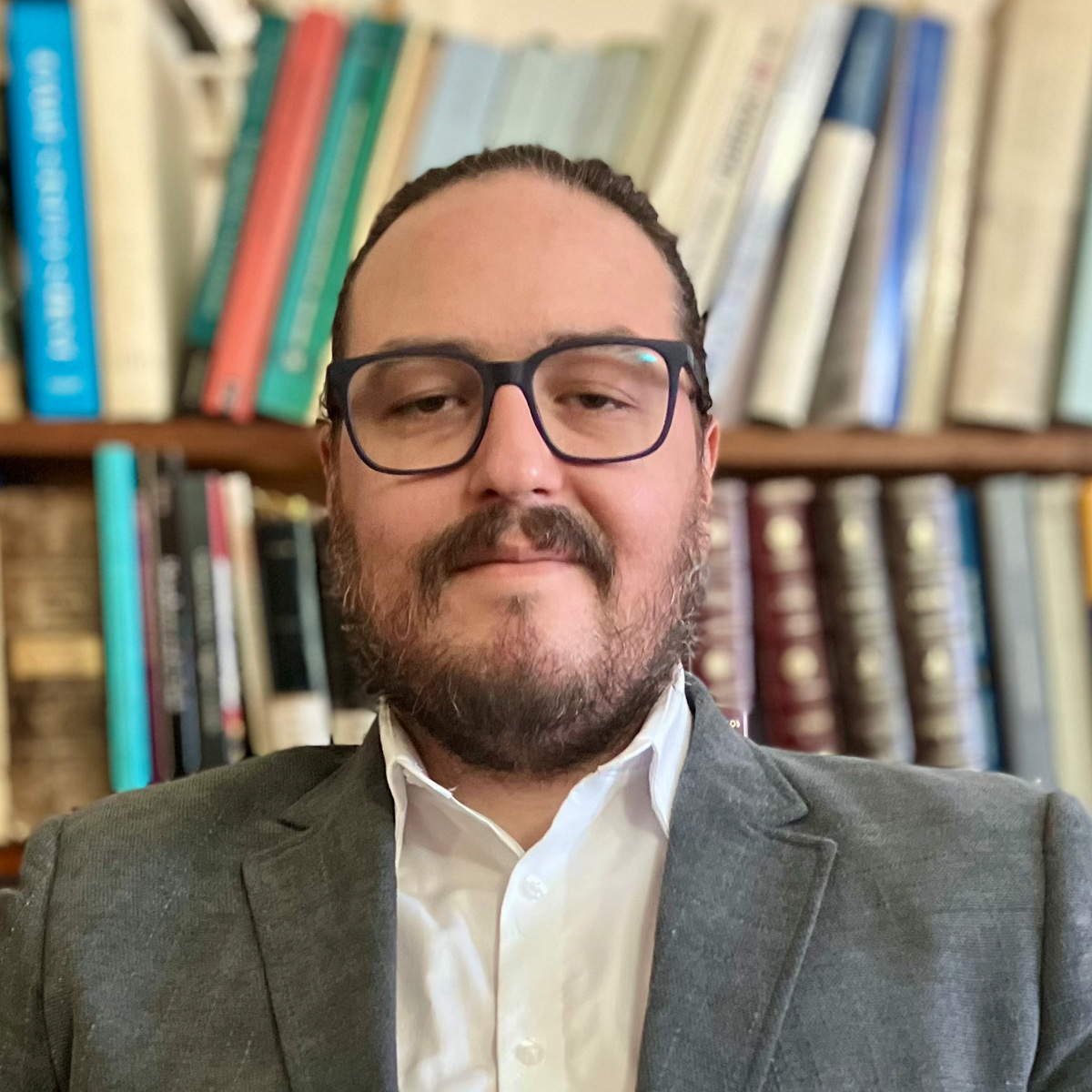
Daniel Pantoja, Doctor of Philosophy from Universidad Diego Portales and Leiden University (The Netherlands), has been awarded the 2026 Cardinal Mercier Prize, conferred jointly by the Institut supérieur de philosophie (ISP) of UCLouvain and the Hoger Instituut voor Wijsbegeerte (HIW) of KU Leuven, in Belgium. The award-winning work is his doctoral dissertation, Categorial Hylomorphism: An Inquiry into the Significance of Categories for the Doctrine of Hylomorphism through a Confrontation of the Ideas of Aristotle and Kant, defended at Leiden in February of this year.
The prize recognizes recent works in metaphysics, first philosophy, or ontology in their relation to the contemporary world, and it is open to students, researchers, and professors from any country. Pantoja, currently an Adjunct Researcher at the Faculty of Social Sciences and Humanities at UDP, is the first Chilean to receive it. The award ceremony will take place during the first half of 2027, on a date yet to be confirmed.
For Rocío Garcés Ferrer, director of the PhD Programme in Philosophy at UDP, the award reflects both the quality of the research and the effort that its development required. “I think it is a well-deserved recognition, because Daniel has been working on this dissertation through many difficulties, with a great deal of time and dedication,” she says.
“It is a very specific prize, because it values work on metaphysical and ontological problems, which were the basis of his research. Being able to publish his dissertation as a book with De Gruyter and receiving the Cardinal Mercier Prize have been two excellent pieces of news, and I believe very well deserved for a work of great difficulty, long in the making and requiring a great deal of effort, as Daniel’s work has been,” she adds.
In the following interview, Pantoja discusses the significance of the prize, explains the central question of his research, and outlines the lines of work that open up from it.
Daniel, what does it mean to you to receive the Cardinal Mercier Prize for your doctoral dissertation?
Receiving the Cardinal Mercier Prize is deeply meaningful to me. It is an award with a long history in my field of research, metaphysics and ontology, and it is conferred jointly by KU Leuven and UCLouvain, two of the universities with the richest philosophical tradition in Europe.
Works by established philosophers are also submitted for this prize: among those who have received it are Nicholas Rescher, Renaud Barbaras, and Paul Humphreys. That it was awarded to me for a doctoral dissertation, only a few months after its defence, makes it all the more significant.
Your dissertation deals with two central concepts in metaphysics: categories and hylomorphism. Could you explain the central question you set out to answer?
Since Aristotle, many philosophers have held that things are composed of matter and form, a doctrine known as hylomorphism. A house, for example, is made of bricks, wood, and cement—its matter—but what makes it a house is the way in which those materials are arranged—its form.
Now, not everything is composed in the same way: a molecule, an organism, and an ecosystem are unities of very different types.
The central question of my research is whether those differences depend on the categories, that is, on the most basic map of reality: the fundamental kinds of entities that we recognize in the world, such as things, qualities, or relations.
To answer it, I brought into dialogue Aristotle, who first formulated the doctrines of the categories and of hylomorphism, and Kant, who radically reformulated both.
What I found is that Aristotle’s categories, centred on individual things, make it possible to explain how each thing is composed internally, whereas Kant’s categories of relation make it possible to explain, in addition, how several things are integrated with one another into larger unities. In general terms, the categorial architecture we adopt conditions how we are to understand the composition of things. I call this idea categorial hylomorphism.
Which aspects of your research do you think were especially valued by the jury? What would you highlight about the research process and about its contribution to future research in this field?
I think the jury valued, first of all, the originality of the work. Categories and hylomorphism are two classical topics in metaphysics, but they are usually studied separately. My work shows that the former internally determine the latter and, on that basis, formulates general principles that any hylomorphic theory should satisfy. Secondly, the result of the confrontation between Aristotle and Kant: far from competing, their hylomorphisms complement each other. Finally, I think it also counted that this is not a purely historical study, but an investigation that draws on two classical authors in order to intervene in a live debate in contemporary metaphysics, which is precisely what the rules of the prize call for.
As for the research process, I would highlight the experience of pursuing the doctorate between Chile and the Netherlands, thanks to the agreement between UDP and Leiden University. Working in an international environment allowed me to discuss my ideas with specialists from different philosophical traditions which enriched the work enormously.
As for its contribution to future research, categorial hylomorphism offers a framework that can be extended beyond Aristotle and Kant: towards other authors of the tradition, towards current debates in analytic metaphysics, and towards applied ontology, that is, the formal systems with which disciplines such as biomedicine or computer science organize large volumes of information.
In what way does this recognition project or drive your work as a researcher? Does it open up new questions or lines of research that you would like to develop?
This recognition encourages me to continue the research programme that I began with my dissertation. The first step is the book Hylomorphism and the Categories in Aristotle and Kant: Foundations for a Contemporary Ontology, in the Philosophical Analysis series of the German publisher De Gruyter. It is not simply the publication of my dissertation, but a revised version: the dialogue between Aristotle and Kant remains at the centre, but with greater emphasis on problems of contemporary ontology.
At the same time, I am beginning a new stage, which moves from formal ontology to applied ontology. On the one hand, I want to extend categorial hylomorphism in dialogue with Husserl and with contemporary metaphysics, something I am working on together with colleagues in the United Kingdom and Germany.
On the other hand, I want to put it to the test in a very concrete domain: nutrition. When we eat a pomegranate, for example, certain gut bacteria transform some of its compounds into new ones that the body can absorb. But not all of us have those bacteria, so two people who eat the same thing may obtain very different effects. This is highly relevant for precision medicine, which seeks to tailor interventions to each person.
And what is interesting from a philosophical point of view is that the outcome does not depend on the food, the bacteria, or the metabolism taken separately, but on how all of them combine. The systems currently used to organize this information in biomedicine are very good at describing each piece, but not so good at capturing how the pieces relate to one another. I believe that philosophy has something to contribute there, and I am already working on this with nutrition specialists such as Dr. Fabián Lanuza, a faculty member at Universidad Católica de Temuco.
The prize confirms that there is genuine interest in the philosophical community in this kind of work, and it is an enormous encouragement to keep going.
After this recognition, what does it mean to you personally to look back and take stock of the path travelled during the doctorate?
The doctorate was a long road and, for various reasons, a difficult one. There were moments when I doubted that I would be able to bring a project of this magnitude to completion. That is why this prize is also for me the confirmation of something I deeply believe in: even if the rhythms of today’s academia push in another direction, research is the fruit of leisure, and a long-term project deserves the discipline and patience it demands. In the end, what remains is the quality of the work.
Finally, I hope this recognition will be a sign that the philosophy done in Chile and Latin America, even if it often works with fewer resources, can engage in dialogue on an equal footing with the great European philosophical tradition.


